
When I first came across Next.js, I wasn’t looking for a full-stack solution - I just wanted a smoother way to build. React development was my comfort zone, but setting up a back-end was always a headache. Next.js - a React framework that quietly rewrote my rule-book. Suddenly, full stack development wasn’t challenging part; it was a flow. Pages rendered faster, APIs lived right beside my components, and deployment felt like magic.
Understanding Why Next.js Is the Ultimate React Framework for Modern Developers
When I first heard about Next.js, I thought “just another React tool” — but it turned out to be so much more. As a React developer, I had grown comfortable with React components, hooks, and crafting UI, but full stack development always felt a bit of a headache for me. I’d build a React front-end, then spin up an Express.js back-end, wire up APIs, manage routing — too many contexts. Next.js blurred those boundaries.
Next.js isn’t just a front-end wrapper on React; it’s a react framework that elevates React development by bundling routing, architecture, and full stack capabilities into one. The mental shift: I could think in pages, endpoints, data, instead of UI vs API vs server. In other words, it gives coherence across nextjs development.
In modern web app development, where performance and SEO matter, Next.js stands out. It supports server-side rendering, static site generation, and hybrid rendering in one toolchain. It felt like the practical React development we had been waiting for.

How Next.js Simplifies Full Stack Development Without Express.js
One of the aha moments for me: with Next.js I can build a full stack development app without ever touching Express.js. No separate back-end repo, no Express routing boilerplate. Everything lives in one unified codebase.
Thanks to Next.js API routes, you simply drop a file under /pages/api/whatever.js (or newer app router conventions) and that becomes an endpoint. This means front-end and back-end code cohabit. The dev experience becomes fluid: if I need a “login” endpoint, I make pages/api/login.js, write my handler, and call it from React components seamlessly.
Because Express isn’t mandatory, setup time plummets. No need to wire express, add middleware, sync Swagger, or maintain two contexts. This simplification removes friction and boosts developer productivity—I focus on features, not plumbing.
Mastering File-Based Routing and Dynamic Paths in Next.js
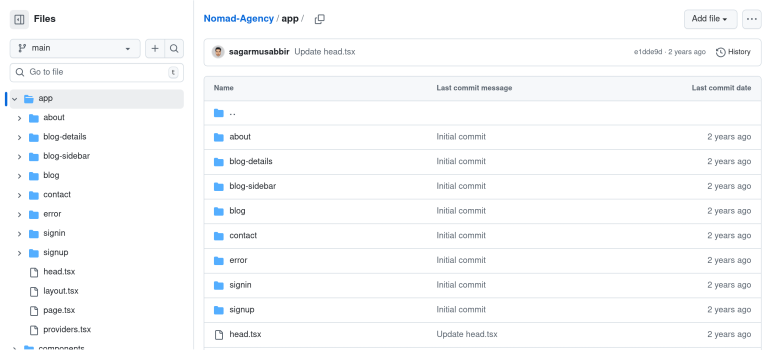
A big charm of Next.js: its file-based routing model. You don’t define routes manually; you create files under pages/ or app/ (depending on version), and the path is implied. pages/about.js becomes /about, pages/blog/[slug].js handles dynamic paths. That intuitive mapping accelerates development.
Dynamic routes follow a clean bracket syntax. So if you want /users/1234, you put pages/users/[id].js. The router hands you router.query.id. It works for nested paths, optional segments, catch-alls, etc. React hooks like useRouter() integrate natively with route params.
This routing model is simple to set up and scales. It treats paths as first-class citizens. For nextjs development, routing becomes more declarative and safer. No mismatches between frontend and backend paths, and path-based logic often feels more maintainable than manual routing in Express.
Building End-to-End JavaScript Applications with Next.js and React
Because Next.js lets you combine front-end and back-end logic seamlessly, you can build a full JavaScript stack. The same language—JS or TypeScript—flows from UI to data. I often write React components that fetch from my own API routes. No context switching, no language boundary.
In a classic MERN (Mongo, Express, React, Node) stack you’d juggle React for UI and Express/Node for backend. With Next.js, it becomes MER: you omit Express. You use Node.js under the hood automatically, but you just write JavaScript or TypeScript across the full stack.
This synergy accelerates feature-building. Need data in a component? Write an API route. Want server-side fetched data? Use getServerSideProps or server components. Want static content? Use getStaticProps. All in one integrated stack.
Leveraging Serverless Functions for Scalable Backend Logic in Next.js
One of the most powerful parts: Next.js deploys API routes as serverless (lambda-like) functions behind the scenes. Your backend logic runs on demand, scales automatically, and you don’t manage servers.
When a request arrives at /api/whatever, the associated function is invoked. No idle processes, no always-on server. This matches modern architectures (Jamstack, serverless) and reduces operational overhead.
That said, serverless has quirks: cold starts, execution limits, latency for heavy libraries. Benchmarking shows that serverless setups achieved higher peak RPS than SSR (1.3M vs ~970K) in controlled tests — elastic scaling wins, though failure rates and cold start latency have to be managed.
In short: serverless backend logic makes nextjs development more scalable, cost-efficient, and infrastructure-light if done thoughtfully.
Optimizing React Development Workflow Using Next.js Features
Once I switched, my React development loop tightened. Hot reloading, fast refresh, and built-in tooling make iteration smooth. Next.js abstracts much of the config so I can just write.
I lean on Next.js best practices: code splitting via dynamic imports, leveraging React hooks for state/data logic, optimizing components, and structuring modules smartly. The mental load shifts from setup to design.
I also adopt native features early: TypeScript with Next.js, automatic image optimization, built-in CSS support, and zero-conf bundling. The more I lean into framework conventions, the less I fight boilerplate.
Enhancing Dynamic Routing with React Context API in Next.js
In projects with deeply nested routes or shared state across dynamic pages, I tap React’s Context API inside Next.js. This lets me propagate context into components deeper along dynamic paths.
Say you have /sections/[section]/items/[id] and some context (theme, user state, permissions) you want accessible across this path tree. You wrap a context provider high and any child component can consume it seamlessly.
Context + dynamic routing becomes especially powerful when your routing logic changes based on some global state (e.g. user role determines which dynamic children are allowed). Next.js routes and React Context become a dynamic duo.
Integrating APIs and Databases Seamlessly in a Next.js Full Stack App
Under the hood, Next.js API routes behave like endpoints. You can connect them to any database—SQL, Mongo, Postgres, Fauna, whatever. Just import your database libraries into the API handler.
For example, /pages/api/posts.js might import a Mongo client, query posts, then return JSON. On the React side, a component fetches via fetch('/api/posts'). It feels like internal RPC.
The separation is flexible. You can also call external APIs or microservices inside the API functions. But the point is: backend integration lives inside the same monorepo. No CORS surprises (same origin), no extra config.
Improving Performance and SEO Through Next.js Server-Side Rendering
Performance and SEO were two of my biggest goals. Next.js helps by enabling server-side rendering (SSR) of React pages so HTML arrives prepopulated. Clients get a fast first paint and engines can index content.
For pages that don’t change often, I use static site generation (SSG) or incremental static regeneration (ISR). That offloads rendering work to build time and scales well.
Since Next.js supports hybrid rendering, you can choose SSR, SSG, or client-only as appropriate. For SEO-critical pages, SSR or SSG wins. For user dashboards, CSR (client-side rendering) may suffice. The mix is flexible. Meanwhile I optimize images, prefetch links, add caching headers and use best practices in web app development and SEO optimization.
At the end of the day, Next.js isn’t just another React framework — it’s the evolution of React development itself. It bridges the gap between frontend and backend, giving developers a seamless path to build, deploy, and scale powerful full stack applications without the usual complexity. From effortless routing to serverless APIs and performance-optimized rendering, Next.js development makes creating modern web experiences faster, smoother, and simply more enjoyable.
If you’re ready to take your next project to the next level, don’t just build — build smarter. Check out our Next.js services and see how our expert team can help you craft scalable, high-performing Next.js solutions that stand out.